9 min read
Disclosure: As an Amazon Associate and eBay Partner Network publisher, we earn from qualifying purchases. This doesn’t affect what we recommend or how we describe it.
Most home gym staples cost less than $80, but a pair of adjustable dumbbells can run up to 20 pounds heavier than a typical kettlebell of the same price—and the difference isn’t just about weight. The real gap comes down to how each tool changes your workout, your results, and even your risk of injury. If you’re comparing dumbbells and kettlebells for strength training, the choice shapes not just your routine, but what you can (and can’t) do with the equipment you buy.
What actually separates dumbbells from kettlebells?
Both are free weights—no moving parts, no electronics, just iron, steel, or sometimes rubber-coated metal. But the similarities stop there. Dumbbells are short bars with equal weights on both sides, meant to be held in one hand (or two for heavier models). Kettlebells look more like a cannonball with a thick handle arching over the top. This basic shape difference leads to critical distinctions in how you grip, move, and load your body during exercise.
With dumbbells, the center of mass sits in your hand. That means you can control the weight precisely during presses, curls, and rows. Kettlebells, on the other hand, have their center of mass below your grip, which makes them feel heavier at the same listed weight and enables swinging, ballistic movements you simply can’t do with a dumbbell.
How the options compare in real use
| Tool Type | Grip Style | Weight Range | Best For | Movement Variety | Price |
|---|---|---|---|---|---|
| Fixed Dumbbells | Straight handle, 1 hand | 1–100+ lbs (0.5–45+ kg) | Isolation, bilateral lifts | High for upper body, moderate for full-body | $$ |
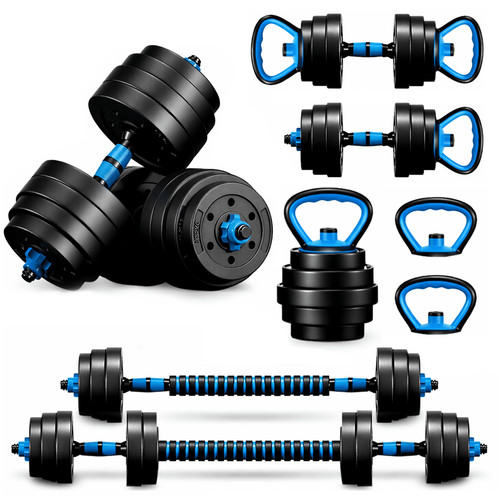
| Adjustable Dumbbells | Straight handle, 1 hand | 5–50 lbs (2.5–23 kg) per dumbbell (common) | Space-saving, progressive overload | Same as fixed, but slower to change weights | $$$ |
| Fixed Kettlebells | Thick handle, 1 or 2 hands | 5–70+ lbs (2–32+ kg) | Swings, cleans, snatches, full-body | High for ballistic & functional moves | $$ |
| Adjustable Kettlebells | Thick handle, 1 or 2 hands | 10–40 lbs (4.5–18 kg) (typical) | Small spaces, variable loads | Moderate—less stable for swings at max weight | $$$ |
| Compact/Travel Dumbbells | Straight handle, 1 hand | 1–10 lbs (0.5–4.5 kg) | Rehab, light toning | Low—mostly isolation | $ |
| Competition Kettlebells | Standardized handle, 1 or 2 hands | 8–32 kg (in 2 kg increments) | Sport, technique consistency | High for Olympic-style lifts | $$$ |
Price: $ = budget, $$ = mid-range, $$$ = premium — relative to the options compared above. Live prices and current stock are below.
The spec most people miss: center of mass
The biggest technical difference between these two tools is where the weight sits relative to your grip—the “center of mass.” With dumbbells, the load aligns right through your hand. That means exercises like biceps curls, chest presses, or lateral raises feel balanced and stable. You’re rarely surprised by the way the weight moves.
Kettlebells shift the center of mass below and away from your grip. This changes everything: during a kettlebell swing, the bell’s momentum pulls your arms and core into action in ways a dumbbell never could. This off-centered load is also why kettlebell training can build grip strength and core stability at the same time as upper or lower body power.
What most buying guides get wrong about versatility
It’s common to see claims that dumbbells are “better for beginners” and kettlebells are for “advanced users.” That’s not accurate. Both can be used by any experience level, but the movement patterns they support are different.
- Dumbbells excel at isolation and symmetrical lifts. You can perform single-joint moves like curls, triceps extensions, and shoulder raises with strict control. They’re also perfect for bilateral lifts (using both arms or both legs at once), such as bench presses or goblet squats.
- Kettlebells unlock ballistic, full-body movements. The unique handle and offset load allow for swings, cleans, snatches, Turkish get-ups, and even loaded carries. These moves challenge your grip, shoulders, hips, and core in ways that are hard to replicate with dumbbells.
Where dumbbells offer more precise load control for traditional bodybuilding or rehab, kettlebells shine for metabolic conditioning and building coordination. Choosing between them should come down to the type of training you want—not your skill level alone.
Why the same weight doesn’t feel the same
Pick up a 20-pound dumbbell and a 20-pound kettlebell, and you’ll notice the kettlebell feels “heavier” in motion. That’s because the weight is farther from your hand and swings in an arc. For static holds or strict presses, the difference is subtle. But during dynamic moves, the kettlebell’s inertia recruits more stabilizer muscles and demands more from your grip.
If you’re new to kettlebells, start with a lighter weight than you’d use for dumbbells. For example, a person who can shoulder-press a 25-pound dumbbell may find a 15- to 18-pound kettlebell challenging for swings or snatches. This isn’t a flaw—it’s a feature that makes kettlebells uniquely effective for power and coordination.
Space, storage, and real-life use
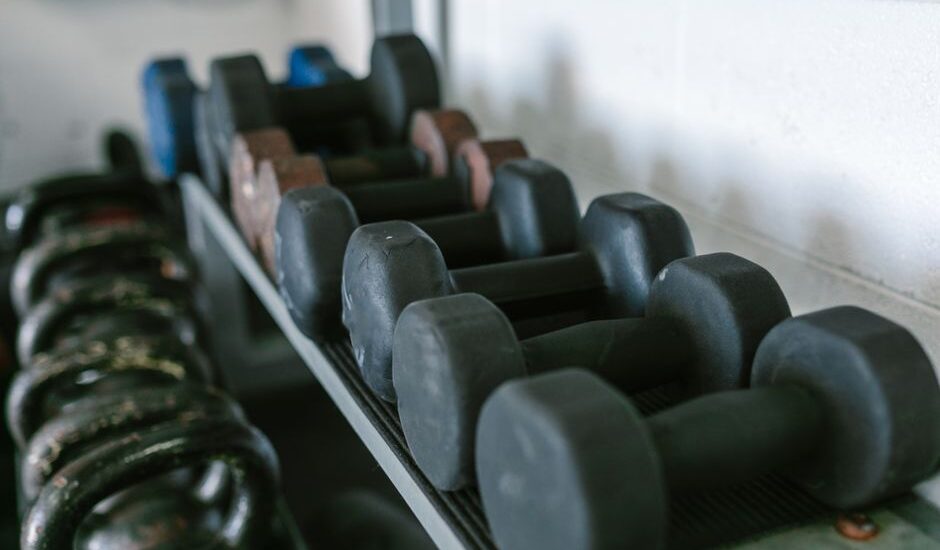
Most people underestimate how much room free weights take up. A full set of fixed dumbbells (e.g. pairs from 5 to 50 lbs) can easily fill a 4-foot rack and weigh over 500 pounds. Adjustable dumbbells reduce this footprint, but the mechanism can make quick weight changes awkward—especially if you’re moving fast between sets.
Kettlebells, thanks to their compact shape, are easier to store individually. You can get an effective full-body workout with just two or three sizes (e.g. 12kg, 16kg, 20kg). Adjustable kettlebells exist, but most max out around 40lbs and can feel unbalanced at higher settings due to shifting internal weights.
If space is tight, or you want to move your gear between rooms, kettlebells are often the more practical option. But for classic bodybuilding splits, dumbbells still rule for variety and progression.
Related Guides
- Our guide to Dumbbells vs Kettlebells: What’s the Real Difference?
- How to Assemble Adjustable Dumbbells: Step-by-Step Guide
- Ankle Braces vs Compression Socks: What’s the Real Difference?
- Our guide to EMS Machine vs TENS: What’s the Real Difference for Pain Relief?
- Humidifiers vs Dehumidifiers: What’s the Real Difference?
- Scoliosis Back Braces That Actually Make a Difference
Red flags in listings to walk past
- No stated handle diameter: Handle thickness matters for grip. If a kettlebell listing omits this, expect a slippery or uncomfortable hold—especially for swings.
- Painted-on weight markings only: Cheap weights sometimes use paint that chips off, making it impossible to tell the weight after a few months.
- No mention of flat base: Kettlebells should have a flat bottom for safe storage and exercises like renegade rows. If the base isn’t specified, it may roll or tip.
- Unspecified material or “mystery metal”: Listings that don’t say “cast iron,” “steel,” or “rubber-coated” may be filled with concrete or sand, which can break or leak.
- Unrealistically low weight range or price: If a set promises 5–50 lbs for a fraction of the normal cost, it’s likely low quality, poorly balanced, or undersized.
Who should use which—and why
If your goal is isolated muscle growth, joint rehab, or you want the widest range of weights, dumbbells make the most sense. They’re also better for people with limited mobility or balance, since you can control the range of motion and keep both arms working equally.
Kettlebells are ideal if you want to combine strength, cardio, and flexibility in one tool. Swings, cleans, and Turkish get-ups offer a time-efficient way to train multiple muscle groups and movement patterns at once. For athletes, kettlebells also help develop explosive power and grip endurance.
But there’s no rule that says you must choose just one. Many well-rounded home gyms include both for maximum training variety.
Common mistakes buyers make (and how to avoid them)
- Buying too heavy, too soon: Especially with kettlebells, overestimating your starting weight leads to poor form and higher injury risk. Start lighter than you think and progress gradually.
- Ignoring handle width and finish: A handle that’s too thick, rough, or slippery will kill your grip and limit use. Look for 28–35mm diameter for dumbbells; 32–38mm for kettlebells.
- Assuming adjustable = always better: Adjustable weights are space savers but can be awkward for fast-paced workouts or exercises requiring a stable base (like renegade rows or swings).
- Not checking for weight accuracy: Budget brands sometimes mislabel weights or have poor quality control. When possible, weigh your gear on a bathroom scale. Tolerance should be within ±3% of stated weight.
For more on safe strength training and equipment selection, see the National Strength and Conditioning Association.
FAQs: Dumbbells vs Kettlebells
Which burns more calories: dumbbell or kettlebell workouts?
Kettlebell workouts typically burn more calories per minute, especially when using ballistic moves like swings and snatches. Studies suggest a 20-minute kettlebell circuit can burn up to 270–400 calories, compared to traditional dumbbell lifting, which is usually lower unless performed as a high-intensity circuit.
How do I choose the right starting weight?
For dumbbells, most beginners start with 5–15 lbs for upper body and 15–30 lbs for lower body moves. For kettlebells, start lighter—8–12 kg (18–26 lbs) for men, 6–8 kg (13–18 lbs) for women—since the offset weight feels heavier in motion. Always prioritize form over load.
Is it easier to build muscle with dumbbells or kettlebells?
Dumbbells are better for isolating muscles and progressive overload, which helps with hypertrophy (muscle growth). Kettlebells build muscle too, but their strength is in full-body moves and conditioning rather than pure muscle isolation.
Can kettlebells replace dumbbells entirely?
Kettlebells cover many of the same movement patterns, but they can’t fully replicate strict isolation or bilateral exercises like chest flyes or triceps kickbacks. For some users, a combination of both offers the most complete training options.
How much space do I need for each?
A pair of dumbbells can fit under a bed or in a small rack, but a full set takes up to 6–8 square feet. Kettlebells are more compact—three bells can store in a corner under 2 square feet. However, allow at least 6 feet of clear space for safe swings and dynamic moves.
Are there any compatibility issues with flooring or surfaces?
Both tools can damage hardwood or tile if dropped. Rubber-coated dumbbells or kettlebells protect floors, but always use a mat for repeated drops. Competition-style kettlebells often have a smoother base, which is less likely to gouge surfaces but can still slide if not used on a non-slip mat.
Bottom line: which tool deserves your money?
If you want the broadest versatility for classic strength training, dumbbells are hard to beat. If your focus is full-body, time-efficient workouts that build power and conditioning, kettlebells deliver unique benefits you won’t get elsewhere. For most home gyms, investing in one or two weights of each gives you the best of both worlds. Before you buy, check current prices, look for handle specs, and never settle for a listing that hides basic details. Compare today’s deals or See what’s available—your training results depend on getting the right tool for your goals and your space.
For additional training safety tips and movement standards, see the American Council on Exercise.


Last updated: June 2026 · About our research