
Disclosure: As an Amazon Associate and eBay Partner Network publisher, we earn from qualifying purchases. This doesn’t affect what we recommend or how we describe it.
Muscle growth isn’t limited to barbells and dumbbells. The right resistance bands can deliver real, measurable hypertrophy—if you pick the correct type, tension level, and design for your goals. Most resistance bands on the market claim they’re “suitable for any workout,” but the reality is that only a handful provide enough progressive overload, stability, and durability to actually build muscle mass over months of use. The crucial differences aren’t always obvious from product images or generic descriptions. This guide cuts through the marketing noise and focuses on what actually matters for muscle building, backed by real specs, user experience, and training context.
Why Not All Resistance Bands Are Equal for Muscle Building
Many bands are designed for rehab, stretching, or light toning—none of which require the sustained, high-tension resistance needed for muscle growth. To trigger hypertrophy, you need bands that deliver at least 30–40 lbs of resistance per band (ideally up to 100+ lbs for compound lifts), maintain that tension through the full range of motion, and don’t lose elasticity after a few months of hard training.
Flat therapy bands (the thin, ribbon-like ones) rarely exceed 20 lbs of resistance even at full stretch. Loop bands and tube bands with handles offer more, but only certain widths and thicknesses provide the strength necessary for actual muscle-building routines. The right pick depends on your training style—are you replicating barbell lifts, targeting smaller muscle groups, or looking for maximum load for legs and back?
Shopping new with fast Prime shipping? Amazon usually has the best stock.
Shop on Amazon →Which Resistance Band Types Actually Deliver for Hypertrophy?
There are three main categories that matter for muscle building:
- 41-inch loop bands: These thick, closed-loop bands (usually 1/2″ to 2.5″ wide) can deliver 15–175 lbs of resistance per band, depending on thickness. They’re ideal for replacing free weights in compound movements (squats, presses, deadlifts), and stacking multiple bands lets you scale up intensity.
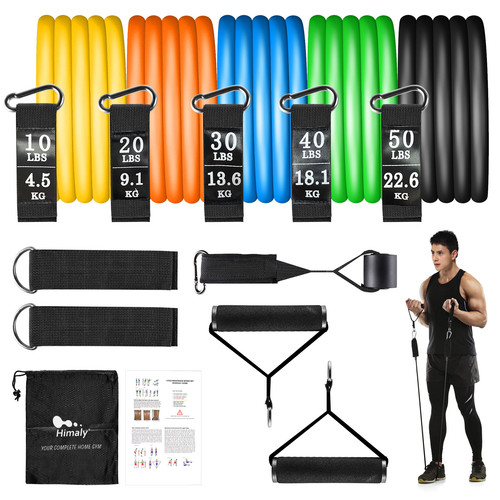
- Tubing bands with handles: Usually 48–60 inches long, these offer 10–50 lbs per tube (often stackable to 100+ lbs) and are best for isolation work, rows, presses, and curls where grip comfort matters.
- Short loop “mini” bands: Designed for hip and glute activation, these bands (typically 12–14 inches in circumference) max out around 40–60 lbs of resistance. They’re not for heavy lifts but are excellent for targeted lower body work and burnout sets.
Fabric bands, often marketed for glute work, generally provide less stretch and a narrower resistance range than latex or rubber but may be more comfortable for high-rep sets and don’t roll up as easily.
How the Options Compare for Serious Muscle Building
| Buying Profile | Resistance Range | Best For | Material & Durability | Exercise Versatility | Real Trade-Offs |
|---|---|---|---|---|---|
| Heavy-duty 41″ loop bands | 15–175 lbs per band | Compound lifts, max tension, progressive overload | Multi-layer latex, 0.5–2.5″ wide; 12–24 months before tension loss | Full-body: squats, deadlifts, presses, pull-ups | Bulky at high widths; can snap if overstretched; latex allergy risk |
| Stackable tube bands with handles | 10–100+ lbs (stacked) | Isolation moves, rows, presses, curls | Single/double-walled latex or TPE, 0.3–0.5″ tubes; 6–18 months durability | Good for upper/lower body; easy grip | Handles can loosen; less stable at max stretch; connectors may fail |
| Short loop “mini” bands | 10–60 lbs | Glute activation, hip work, burnout sets | Latex or woven fabric; 1.5–3″ wide; 6–12 months before rolling/stretching out | Lower body, core, rehab | Limited to smaller muscle groups; low max tension |
| Fabric “comfort” bands | 15–45 lbs | High-rep glute/leg work, comfort-focused | Polyester/cotton blend; very low risk of snapping | Lower body, pilates, stretching | Less stretch, can’t replace free weights for heavy lifts |
What Resistance Levels Are Needed for Real Progress?
For muscle growth, you need to work within 60–85% of your one-rep max (1RM) for each movement, which often requires 40–80 lbs of resistance per arm/leg on compound exercises. Most general-purpose bands stall out at 30 lbs, which is enough for beginners but not enough for sustained progress. Advanced loop bands (2″ wide or more) can deliver up to 175 lbs when doubled, enough to challenge even seasoned lifters on squats and rows. For isolation moves, tubes that can be stacked to 80–100 lbs let you replicate cable machine tension at home.
Look for clear resistance ratings per band, not just a “total” for the whole set. If a manufacturer doesn’t specify the actual resistance at a given stretch length (usually 100% elongation), treat the claims skeptically. A quality band should clearly state, for example, “Blue: 50–125 lbs at 100–200% stretch.”
Durability and Material: What Actually Lasts Under Heavy Use?
Latex bands deliver the most consistent tension curve, but single-layer bands (especially cheap ones) are prone to snapping after 6–12 months of heavy training. Multi-layer “laminated” latex construction increases lifespan to 18–24 months and resists micro-tears. TPE (thermoplastic elastomer) is sometimes used for allergy reasons but offers less stretch and less “snap back” at high resistance.
Handles and connectors are the weak point for tube bands—look for double-stitching and metal carabiners, not plastic clips. For fabric bands, reinforced stitching at the seams is essential; otherwise, they roll up or stretch out after a few months. See what’s available for bands with verified multi-layer construction and robust handle systems.
Why Band Width and Length Change Your Workout
Width directly correlates to resistance: a 2.5-inch loop band can deliver up to 175 lbs, while a 0.5-inch band may only provide 15–30 lbs. Longer bands (41″ standard) allow for deadlifts, squats, and presses, while shorter loops (12–14″) are only suitable for limited range exercises like glute bridges or lateral walks.
For taller users (over 6′), look for bands at least 41–45 inches long to avoid limited range of motion. Shorter bands will “bottom out” before you reach full extension, reducing tension at peak contraction. Conversely, if you primarily do seated or isolation work, shorter tubes or loops can provide more constant tension without excess slack.
Related Guides
Why Handles, Anchors, and Accessories Matter for Muscle Building
Muscle growth depends on consistent, controlled tension—something that’s hard to achieve if your hands slip or the band snaps back mid-rep. Handles with knurled rubber grips (1.2–1.5″ diameter) prevent slippage, especially when you’re sweating. Door anchors rated for at least 200 lbs of pull force let you safely replicate cable machine angles for rows, presses, and flys. Ankle straps (with double-stitched loops) are crucial for consistent lower body work, especially for kickbacks and abductions.
Cheaper sets often include plastic handles and thin anchors that fail under heavy load. If you plan to routinely stack bands for squats or presses, prioritize sets with metal carabiners and reinforced stitching. Compare today’s deals for kits that include these pro-level accessories.
Common Mistakes: Why Many People Plateau with Bands
Most muscle-building plateaus with bands come down to two issues: insufficient resistance and loss of tension over time. Many users start with a set that maxes out at 30–40 lbs per band, which is quickly outgrown. Even worse, bands that lose 10–20% of their tension after a few months make it impossible to continue progressive overload—your muscles adapt and stop growing.
Another common error is relying on “stacked” tube bands with weak connectors. If the clips or handles fail at high loads, you’re at risk for injury and wasted workouts. Always inspect bands monthly for cracks, thinning, or overstretched sections. Replace any band that shows visible wear—no matter the brand or price point.
Finally, using the wrong length or width for your exercise can limit range of motion and reduce muscle activation. For example, trying to squat with a short mini band will never provide enough tension or full range. Match the band spec to the movement, not just the color code.
Best Picks by Training Profile: Which Band Type Matches Your Routine?
- Full-body free weight replacement: Go for a set of 41-inch loop bands (0.5″ to 2.5″ wide) with clear resistance ratings up to 175 lbs. These let you perform presses, squats, deadlifts, and even assisted pull-ups with real progressive overload.
- Home gym with cable-style workouts: Choose stackable tube bands with handles and metal carabiners, rated for at least 100 lbs when combined. Prioritize sets with a sturdy door anchor and ankle cuffs for maximum versatility.
- Glute and hip specialization: Opt for wide (2–3″ fabric) mini bands or heavy latex loops with at least 40 lbs max resistance. These are ideal for activation sets, hip thrusts, and burnout finishers.
- Travel and portability: Select a compact tube set (up to 50 lbs per band) with a lightweight anchor and quick-attach handles. These fit in a carry-on and allow for basic presses, curls, and rows anywhere.
Check current prices for band sets matched to your training priorities.
Shopping new with fast Prime shipping? Amazon usually has the best stock.
Compare Options on Amazon →FAQs: Real Questions About Building Muscle with Resistance Bands
Can resistance bands really replace free weights for muscle growth?
For most movements, high-quality resistance bands with sufficient tension (40+ lbs per band) can provide the progressive overload needed for hypertrophy. While you may miss out on some stability and grip challenges of free weights, bands can effectively trigger muscle growth when used with proper form and resistance.
How do I know if a band provides enough resistance for muscle building?
Check the stated resistance at a given stretch length (usually 100% elongation). For muscle growth, you generally want bands that reach at least 40–100 lbs of resistance for compound lifts. If the manufacturer doesn’t specify these numbers, the bands are likely not strong enough for serious strength training.
How long do resistance bands last with regular muscle-building workouts?
Heavy-duty latex loop bands typically last 12–24 months with regular use, while tube bands may need replacing after 6–18 months, especially at higher tension. Inspect bands monthly for wear—visible cracks or thinning signal it’s time for a replacement to avoid snapping.
Are fabric bands better than latex for building muscle?
Fabric bands are more comfortable and tend to roll less, but they usually provide less stretch and lower max resistance (up to 45 lbs). For heavy lifts and full progressive overload, latex bands are more effective, but fabric bands work well for high-rep glute and hip work.
What safety precautions should I take when training with resistance bands?
Always check for signs of wear before each session, use proper anchors or secure attachment points, and avoid overstretching bands beyond their rated length. Never face the anchor point directly—if a band snaps, it can recoil dangerously. Use metal carabiners and reinforced handles for high-resistance exercises.
Can resistance bands help advanced lifters keep gaining muscle?
Yes, if you use bands that provide enough resistance (up to 175 lbs for heavy loop bands) and keep progressing load or reps. Advanced lifters often benefit from combining bands with free weights or stacking multiple bands to keep challenging their muscles.
Bottom Line: Which Resistance Bands Are Actually Worth It for Muscle Building?
If you’re serious about building muscle with resistance bands, skip the generic “fitness” sets and focus on bands that deliver real, quantifiable resistance—ideally 40–175 lbs per band, durable multi-layer construction, and pro-level accessories. Loop bands are best for replacing big lifts, while tube sets with robust handles and anchors let you mimic cable machines at home. Inspect for quality and replace bands as needed; your progress depends on it. The right bands aren’t just a backup for weights—they’re a versatile, effective muscle-building tool in their own right. View options and invest in bands that will actually grow with your strength.