
10 min read
Disclosure: As an Amazon Associate and eBay Partner Network publisher, we earn from qualifying purchases. This doesn’t affect what we recommend or how we describe it.
The cheapest heated lumbar support pillows for office chairs start around $35, but top-tier models can reach $120 or more—yet the difference is rarely just about heat. Most buyers expect a basic heating pad and some memory foam, but what actually separates a $40 pillow from a $100 one is a mix of heat distribution, adjustability, safety certifications, and whether it stays in position for an eight-hour workday. Understanding these specifics is the only way to avoid buying a pillow that feels great for five minutes but fails when you need it most.
Why most “heated” lumbar pillows disappoint after a week
Out of dozens of heated lumbar support pillows marketed for office chairs, only a handful deliver both real ergonomic support and consistent, safe warmth. Many low-cost options use a single thin wire or carbon film for heat, which often fails to cover the full lumbar area (typically only 12–15 cm wide). This leads to hot spots and cold edges. Others lack any real lumbar contouring—meaning you get heat, but not the crucial lower back support that prevents fatigue and stiffness.
Another common pitfall: temperature control. Entry-level pillows usually offer just one or two heat settings, sometimes as vague as “low/high”—with little information about actual temperature output. More advanced models offer 3–5 settings, with temperature ranges from 38°C to 55°C (100°F to 131°F), and include automatic shutoff for safety. That’s not a luxury: without a timer, leaving a heated pillow on for hours can be a fire risk, especially on older office chairs with synthetic upholstery.
Finally, few buyers realize how much the attachment system matters. Generic elastic straps often sag or slip, especially on mesh-back or curved chairs. The best designs use dual adjustable straps at both the top and bottom, spanning 25–45 cm, to anchor the pillow securely—critical if you shift positions or share your chair with others.
How the main options stack up: comparison table
| Configuration | Heat Coverage | Lumbar Support | Attachment System | Heat Settings | Price |
|---|---|---|---|---|---|
| Basic heated pad insert | ~12×15 cm center zone | Minimal (flat or thin foam) | Single elastic strap | 1–2 (low/high) | $ |
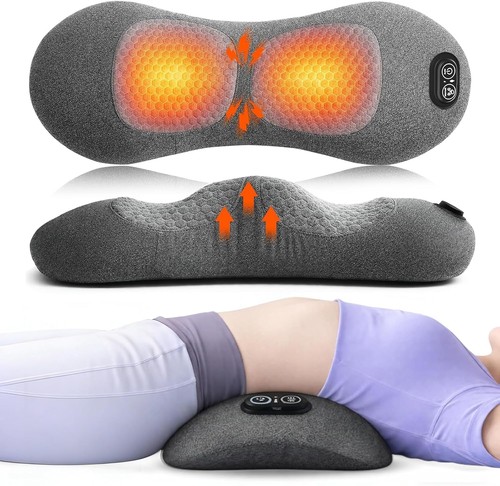
| Contoured memory foam with heat | Full lumbar curve (20×30 cm) | Medium-firm (4–8 cm thick foam) | Dual adjustable straps | 3–5 (38–55°C) | $$ |
| Heated mesh ergonomic support | Wide (25×35 cm), breathable | Firm (integrated frame) | Top/bottom buckle straps | 3 (auto shutoff) | $$ |
| Rechargeable cordless heated lumbar | Mid-zone (15×20 cm) | Soft (3–5 cm foam) | Velcro wrap or slip-on | 2–3 (battery lasts 2–4 hrs) | $$$ |
| Full-back heated cushion | Entire back (40×60 cm) | Light lumbar ridge | Seat anchor + straps | 5 (remote, 30–60 min timer) | $$$ |
Price: $ = budget, $$ = mid-range, $$$ = premium — relative to the options compared above. Live prices and current stock are below.
The spec almost nobody talks about: heat uniformity vs. hot spots
Many heated lumbar pillows advertise a “large heating area,” but only a few provide even warmth across the curve of your lower back. Look for models specifying at least a 20×30 cm heated zone for true lumbar coverage. If a product lists only “center heating” or avoids stating the area, expect a narrow strip that leaves your sides cold.
Uniform heat distribution relies on the placement and density of heating wires or films. Multi-loop wire patterns (visible in some teardown images) or carbon fiber mesh offer the best coverage. Uneven heat isn’t just uncomfortable; it can cause skin irritation or pressure points during long sessions.
Always check for overheat protection—a cutoff at 55°C (131°F) is standard for safety. If a pillow lacks an auto-shutoff after 30–60 minutes, that’s a red flag. For reference, the Consumer Reports recommends auto-shutoff for any heated home device used for more than 20 minutes at a stretch.
Why lumbar support shape matters more than you think
True lumbar support means holding your lower spine in its natural curve (lordosis), which varies by body size and chair type. The best heated pillows use memory foam 4–8 cm thick at the center, tapering at the edges, to preserve that curve without overextending your back. Cheaper options use flat or minimally contoured foam, which provides warmth but little real support.
For most adults (height 160–190 cm), a lumbar pillow should be 35–45 cm wide and 12–18 cm tall to fit the natural curve. If you’re shorter or taller than average, look for adjustable-height or multi-position designs. Overly thick pillows (over 10 cm) may push you too far forward, while extra-thin pads (<3 cm) are nearly useless for active support.
Some mesh models use a built-in frame or S-shaped profile to maintain lumbar alignment, but these are rarely heated across the entire structure. If you want both rigid support and heat, focus on hybrid designs with both a contoured core and a distributed heating layer.
Attachment systems: what actually keeps the pillow in place?
Most heated lumbar pillows attach with a single elastic strap, 30–60 cm long, designed to fit “all chairs.” In practice, this means it slips on narrow-backed chairs and barely stretches over executive or gaming chairs. The best pillows use two separate adjustable straps—one at the top, one near the base—each with 10–20 cm of adjustment range. This keeps the pillow anchored during movement and fits a wider range of chair shapes.
Look for buckles or heavy-duty Velcro rather than simple elastic loops. If you use a mesh-back chair, ensure the straps are wide (at least 3 cm) and won’t cut into the mesh or slide out of place.
Rechargeable cordless models often use a wraparound Velcro band or slip-on sleeve, which is convenient for portability but may not fit wide or contoured office chairs. Always check the listed maximum and minimum strap lengths—if the listing omits them, expect a poor fit.
Compare today’s dealsRelated Guides
- Heated Lumbar Support Pillows for Office Chairs: Do They Really Work?
- Orthopedic Pillow vs Memory Foam Pillow: Which Is Better for Sleep Support?
- Posture Corrector Seat Cushions for Comfortable Support
- Adjustable Bed vs Wedge Pillow: Which Sleep Solution Is Better for You?
- Our guide to Are Heated Blankets Safe? What You Need to Know Before Buying
- Which Chair Is More Ergonomic? How to Make the Right Choice
Red flags in listings to walk past
- No stated dimensions: If the seller doesn’t specify the pillow’s size (in centimeters or inches), you’re likely looking at a generic import with unpredictable fit.
- Only USB-powered, no wall adapter included: Many listings claim “USB-powered for convenience,” but omit that you’ll need a separate adapter for wall use. USB ports typically output 5V at 1–2A, which may not deliver enough heat for office use.
- Vague heat settings: Descriptions like “warm and soothing” or “adjustable heat” without actual temperature ranges (in °C or °F) suggest minimal or inconsistent heating.
- No mention of auto-shutoff or safety certification: Heated products should list an auto-shutoff (30–60 minutes) and at least one safety mark (UL, CE, or equivalent). Absence of these is a major risk.
- Stock photos only, no in-use images: If all images are stock renders or don’t show the pillow on a real chair, expect quality issues or misleading proportions.
Common mistakes buyers make with heated lumbar pillows
Many buyers assume “any heat is good heat,” but excessive warmth can dry your skin or even lead to low-grade burns with prolonged use. The best pillows limit max temperature to 55°C and include a timer. Another mistake: using a lumbar pillow as a fix for a poor office chair. Even the best pillow can’t compensate for a sagging seat or broken backrest.
Some users expect a heated lumbar pillow to double as a massage device—while a few models add vibration, most lack the power or placement to provide true relief. If you want both heat and massage, look for a full-back cushion with separate controls for each function (often at a higher price tier).
Finally, don’t overlook hygiene: removable, washable covers are essential. Many heated pillows have non-removable covers that collect sweat and dust, especially in warm offices. Look for models specifying machine-washable covers and avoid those that can only be spot-cleaned.
See what’s availableWhat most buying guides get wrong about power sources
Power matters more than most guides admit. USB-powered pillows are common, but standard USB 2.0 outputs just 5V at 0.5A—enough for gentle warmth, but rarely enough for sustained deep heat. For office use, a wall-powered pillow (AC adapter, 100–240V input) is preferable for continuous warmth and higher temperature settings.
Rechargeable cordless models trade runtime for convenience. Expect 2–4 hours per charge at medium heat, with a 2–3 hour recharge time. These are best for situations where you can’t access an outlet, but not for all-day use. Always check for overheat protection and battery safety certifications—lithium-ion batteries should be rated for at least 500 charge cycles.
View optionsFAQ: heated lumbar support pillows for office chairs
How long does it take for a heated lumbar pillow to reach full temperature?
Most models reach their maximum heat setting within 5–10 minutes. Entry-level USB-powered pillows may take up to 15 minutes, while wall-powered options usually heat up faster. Check the product specifications for preheat times, especially if you want immediate warmth during short breaks.
Heated lumbar pillow vs. heated seat pad—what’s better for office use?
A heated lumbar pillow targets your lower back, offering both warmth and spinal support, while a heated seat pad warms your entire seat and sometimes your thighs. For posture and back pain prevention, a lumbar pillow is more effective. Seat pads are better for overall body warmth but provide little ergonomic benefit.
Will a heated lumbar pillow fit my office chair?
Fit depends on the pillow’s width, strap length, and your chair’s design. Most standard pillows (35–45 cm wide) fit typical office chairs, but oversized executive or gaming chairs may require extra-long straps. Always measure your chair’s backrest and compare with the product’s listed dimensions and strap range.
How safe are heated lumbar pillows for all-day use?
Quality models with auto-shutoff (30–60 minutes) and overheat protection are generally safe for extended use. However, it’s best to cycle usage—heat for 20–30 minutes, then turn off—especially if you have sensitive skin or pre-existing back issues. Avoid pillows without safety certifications or clear shutoff features.
Can I use a heated lumbar pillow with a mesh-back chair?
Yes, but make sure the pillow has wide, adjustable straps and a non-slip backing. Narrow or single straps can slip through mesh or fail to anchor, reducing both support and heat transfer. Some mesh-back compatible pillows use hook-and-loop systems for better stability.
What’s the warranty or return policy for these products?
Most reputable heated lumbar pillows offer a 1-year warranty, covering defects in materials and heating elements. Return policies vary—some sellers offer 30–60 day trial periods, while others accept returns only for unopened products. Always check for clear warranty terms and avoid listings with no stated return policy.
Do heated lumbar pillows lose effectiveness over time?
Heating elements can degrade after 500–1,000 hours of use, leading to uneven warmth or complete failure. Memory foam may also lose its shape after a year or more of daily use, especially if the pillow lacks high-density materials. Regularly inspect your pillow for cold spots or flattening to ensure continued support and safety.
Bottom line: what’s worth paying for in a heated lumbar pillow?
For most office workers, a mid-range contoured memory foam pillow with a 20×30 cm heating zone, 3–5 temperature settings, dual adjustable straps, and a removable cover hits the sweet spot of comfort and safety. Cheaper models rarely deliver both reliable heat and ergonomic support, while premium options add features like cordless use or full-back coverage that only matter for specific needs. Pay attention to real specs—especially heat area, support shape, and safety features—and skip any listing that won’t show you numbers. For those who spend long hours at a desk, a well-chosen heated lumbar support pillow is one of the few desk upgrades that delivers real, lasting comfort.


Last updated: June 2026 · Our editorial process